TL;DR: Tulsa County and City emergency leaders say every household needs its own written backup plan for power loss, separation, and failed phones during September's National Preparedness Month.
Answer first: make a family plan, build a kit, and line up trusted alerts before you need them.
Emergency managers across Tulsa County activated coordinated responses almost weekly in recent weeks, and on Sept. 2, 2026, county and city directors told families to build the same kind of redundancy at home, as reported in Tulsa emergency managers urge families to prepare backup plans before disaster strikes.
The message was timed to National Preparedness Month this September. Tulsa County Emergency Management Director Bill Smiley and Tulsa City Emergency Management Director Adam Woodard each described what local teams do and what households should copy: decide how you will communicate, where you will meet, what you will carry, and where you will get verified information when phones and power fail.
Why Tulsa leaders issued the warning now
Smiley said recent county activations included an incident in Glenpool and a landfill fire near Highway 75. In his words, teams had faced something pretty much every week requiring an incident command setup or a joint operations center.
Those structures bring together first responders, government agencies and other resources during disasters. Tulsa County also works with the state, surrounding counties and, when necessary, federal agencies to secure additional assistance.
Smiley framed local risk in direct terms, warning residents never to assume they are overprepared and noting the region is prone to action, especially natural disasters. That context is why county and city officials used the September observance to press households to write their own plans now rather than improvising during an event.
A companion city announcement and related coverage in Tulsa officials urge residents to prepare ahead of disasters distilled the ask into three household actions: create an emergency plan, build an emergency kit, and know where to get reliable emergency information.
Step 1: Write a plan that works away from home
Woodard said communication should sit at the center of every family plan. His caution was practical: households may lose power or face cell phone outages, so they need a prearranged way to reach each other when trouble starts.
City guidance urges families to talk through four questions together: how alerts will be received, where people will shelter inside the home, where and how they will leave the home, and how they will communicate afterward. The discussion should cover separation during a normal day, not only evenings together.
The FOX23 report stressed the plan must function whether members are at home, at work, traveling or on the road when a disaster occurs. Families were advised to pick both a contact method and an in-person meeting location for cases where members are separated.
Household plans will differ, officials said. Effective versions account for prescription medications, medical equipment, children, older relatives, disabilities, pets and other individual needs rather than assuming one template fits all.
What county teams model for redundancy
Smiley said Tulsa County applies the same principle it recommends to families to its own emergency communications. The county keeps at least three or four backup systems in place.
Those backups include radios, satellite phones, landlines and paper copies of critical information. If electronic links collapse entirely, the fallback is human relay — in Smiley's description, assigning someone to run and deliver a message.
For a prepared household, the lesson is parallel: do not depend on a single phone, a single app, or memory. Keep contact numbers on paper, keep charging options packed, and assign out-of-area contacts and meeting points ahead of time so a dead battery does not erase the plan.
City materials add that planning ahead before disaster strikes can often reduce stress and save money, and can save lives by saving precious time. The point is not paperwork for its own sake but faster decisions when minutes matter.
Step 2: Build a kit for daily needs first
Both city and county officials told families to start a kit by listing what household members use every single day, then deciding which of those items would matter most without utilities or stores.
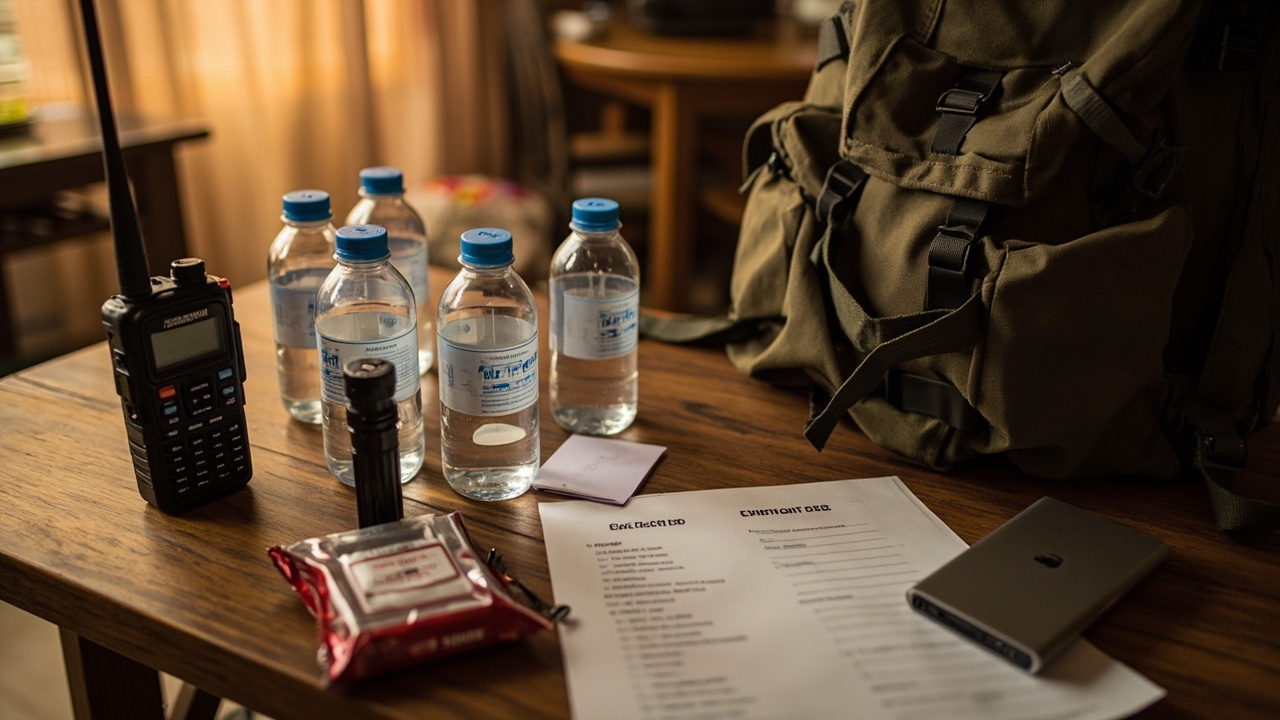
City guidance describes a basic kit as containing a flashlight, a first-aid kit, water, food, a battery-powered or hand-crank radio, printed copies of emergency contact numbers, and chargers or batteries for electronic devices.
The county-level checklist reported Sept. 2 was more detailed. A basic emergency bag can include water and nonperishable snacks, prescription medications, a flashlight and additional batteries, a first-aid kit, a battery-powered or hand-crank weather radio, extra phone chargers or portable power banks, printed emergency contacts, copies of identification, insurance policies and other important documents, supplies for children and pets, and roadside equipment including jumper cables if the kit is kept in a vehicle.
Medications and medical equipment deserve special attention. Families were urged to consider refrigerated drugs, mobility devices, infant formula, pet food, and care needs for older relatives or household members with disabilities when sizing water, food and supplies.
The city also advises keeping copies of important documents like insurance policies, identification and bank account records saved electronically and accessible online, while also retaining printed contacts and document copies for outages. Residents were told to store identification, insurance policies and financial records securely yet accessibly if evacuation becomes necessary.
Step 3: Choose trusted information before the sirens sound
Woodard said families should decide in advance where they will get reliable information. He warned that heavy reliance on social media can mislead, because posts there may not be the most accurate source during fast-moving events.
Instead, he recommended monitoring local emergency management agencies, the National Weather Service and local news organizations rather than relying only on unverified social posts. The city release lists the National Weather Service office serving Tulsa, local government channels and local news providers as preferred starting points.
Officials also urged residents to make sure Wireless Emergency Alerts are enabled on phones and to learn what local outdoor warning sirens sound like. At the same time, they cautioned that outdoor sirens should not be a household's only way of receiving a warning, since indoor audibility varies and sirens convey limited detail.
Woodard recommends having multiple ways to receive information, including a battery-powered or hand-crank weather radio. City checklists specifically point to NOAA Weather Radio for local alerts when cellular networks or home internet drop.
The city points families to the FEMA App, available in English and Spanish, for weather alerts and safety tips, alongside the National Weather Service Tulsa web page and social channels and instructions for enabling Wireless Emergency Alerts. Officials said the best time to sign up for alerts is now, from trusted sources, rather than searching for them during an actual emergency.
Free planning guides Tulsa families can use tonight
Families can use the Oklahoma Department of Emergency Management's Make a Plan guide to consider possible disasters, create shelter and evacuation plans, establish ways to communicate and tailor emergency supplies to specific household needs.
Federal resources provide a parallel worksheet. FEMA's family emergency plan guide helps households outline contacts and carry key details after the disaster passes, such as family doctor information, insurance information and contact information for family and friends.
City officials also point to basic emergency supply lists for home and vehicle kits. Officials say preparedness does not have to be complicated, and taking a few steps before an emergency can help families respond more effectively when severe weather or another disaster strikes.
Woodard summarized September's goal as three simple steps for Tulsans: make sure the family has an emergency plan, build an emergency kit, and know how to get emergency information. His closing takeaway was that preparing in advance can make a huge difference when an emergency does happen.
How personal readiness helps neighbors
Smiley tied household action to community capacity. Individual preparation lets first responders concentrate on hospitals, critical infrastructure and people who cannot prepare or care for themselves.
In his formulation, being prepared for a disaster means being ready to support yourself, which actually supports the community. A household that can shelter, communicate and sustain medications for the first stretch reduces calls for rescue and welfare checks.
That coordination role is central to emergency management. Teams help coordinate first responders, government agencies and other resources, and the City of Tulsa Department of Emergency Management serves as the central coordinating entity for preparedness, mitigation, response, recovery, continuity of government and resilience planning within the city.
Department duties include maintaining emergency operations plans, conducting hazard assessments, coordinating response activities within city limits and ensuring continued operation of outdoor warning sirens. The department coordinates with all city departments before, during and after emergencies.
Flood work behind the September push
Tulsa's Stormwater division manages flood-control efforts, including watershed management, stormwater detention basins and creek management, plus a prototype alert system for flooding noted in the city release.
That work contributed to Tulsa receiving a Class 1 rating through FEMA's Community Rating System for comprehensive floodplain management. City officials said the rating has resulted in lower flood insurance rates for residents.
For families, the reminder is twofold: review floodplain maps and flood safety information for your address, and keep identification, insurance and financial records ready to prove loss and speed recovery. The city points residents to flood-control pages for history, maps and safety steps.
If there is one household project to finish during National Preparedness Month, Tulsa leaders say it is the backup plan for communications and meeting places, backed by a charged radio, printed contacts and a go-bag that reflects medications, kids, elders and pets.