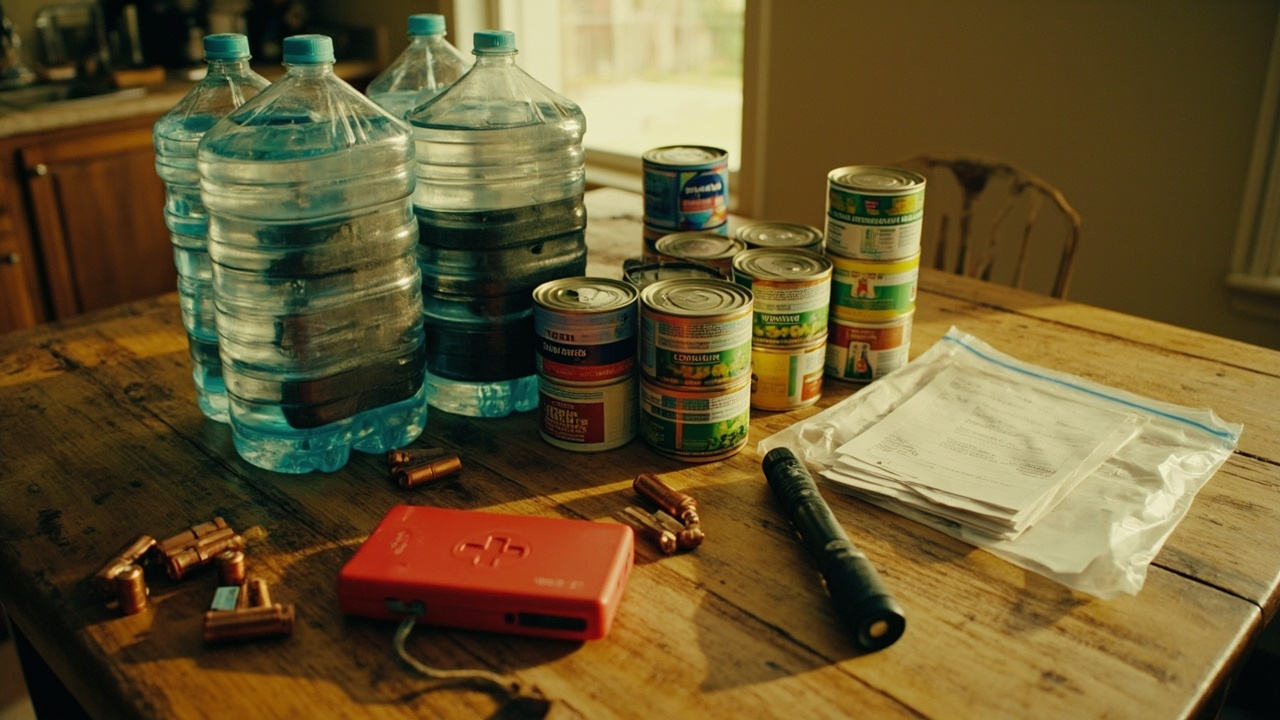
TL;DR: Houston families can reach 5 to 7 days of self-sufficiency for hurricanes, floods and outages by adding about $2 of extra food per grocery trip, storing water gradually, and using free plans, alerts and local help.
Income gap drives Houston preparedness divide
Published October 9, 2026 at 6:13 PM, reporting by Joy Addison and photojournalist Jeovany Luna for Click2Houston found nearly half of Houston-area respondents in households earning less than $25,000 a year said they would be "not at all" or "not too prepared" if a natural disaster struck.
That finding, drawn from a Rice University Kinder Institute for Urban Research study, points to a gap between lower- and higher-income households in how ready they feel for hurricanes, floods and extended power outages.
Daniel Potter, director of the Houston Population Research Center at the Kinder Institute, said preparedness can be difficult when basic supplies cost money that families may not have available, according to Click2Houston.
"Many of us do not have those kind of resources," Potter said.
A research snapshot released September 23, 2026 by the Kinder Institute for Urban Research adds detail, reporting that the average Houston-area resident has taken five of the 10 key household preparedness actions tracked in the Federal Emergency Management Agency National Household Survey.
The same snapshot reports that residents in higher-earning households feel more prepared and take more preparedness actions than those in lower-earning households.
It also reports that four in 10 Houston-area residents own a generator that can be used to power their home during extended power outages, with ownership varying significantly by neighborhood and income level.
What a full kit would cost at once
Bryan Murray, deputy director and public information officer for the Harris County Office of Homeland Security & Emergency Management, acknowledged that building a complete emergency kit all at once can be financially out of reach, according to Bayou Beat News.
"If I gave you our preparedness list and said go buy all this, it's probably about $500," Murray said.
That $500 estimate explains why emergency managers urge gradual buying rather than one large shopping trip before a storm enters the Gulf.
Cam, a Houston-area resident originally from Louisiana who is familiar with hurricanes and tornadoes, estimates spending hundreds of dollars each year on supplies, including bottled water, snacks and portable chargers, according to Click2Houston.
Cam said economic pressure is widespread and encouraged saving what can be saved, even in small amounts.
Gabrielle Delasbour, another Houston resident interviewed by Click2Houston, said she keeps flashlights, candles, matches, water, canned goods and toiletries at home but does not own a generator.
Aim for 5 to 7 days of self-sufficiency
Brian Murray with the Harris County Office of Emergency Management said residents should aim to have enough supplies to remain self-sufficient for five to seven days after a disaster, according to Click2Houston.
Emergency assistance can take time to arrive, and officials may not be able to meet every household's needs immediately.
Murray recommends starting with essentials such as water and nonperishable food before considering more expensive purchases.
Families should also consider specific needs, including prescription medication, medical equipment and supplies for pets, according to Click2Houston.
Ready.gov's Build A Kit guidance lists water at one gallon per person per day for several days, for drinking and sanitation, plus at least a several-day supply of non-perishable food.
That federal checklist also names a battery-powered or hand crank radio and a NOAA Weather Radio with tone alert, flashlight, first aid kit, extra batteries, whistle to signal for help, dust mask to help filter contaminated air, and plastic sheeting, scissors and duct tape to shelter in place.
It further names moist towelettes, garbage bags and plastic ties for personal sanitation, wrench or pliers to turn off utilities, manual can opener for food, local maps, and cell phone with chargers and a backup battery.
The $2-per-trip grocery method
Murray's budget approach centers on adding a small amount to a regular grocery bill, according to Bayou Beat News.
"Buy an extra can of green beans and an extra can of tuna every time you go to the grocery store," Murray said. "So you're adding maybe $2 to your grocery bill, but over time you're building that up."
He offered the same gradual advice for bottled water, suggesting families purchase a case every other week, according to Bayou Beat News.
"You can build it up gradually," Murray said. "It makes much more sense from a budget standpoint for most people, but it still gets you to the point where you've got some readiness built into your family's routine and your budget."
Click2Houston quoted a closely matching recommendation from Murray to pick up an extra few cans of tuna, green beans or another liked food during each grocery visit and set those cans aside just for disasters.
Delasbour described the same habit in practice, saying she gradually builds supplies during grocery trips by buying extra water and other necessities when she can, according to Click2Houston.
Ready.gov's Low and No Cost Preparedness page gives the same start-with-what-you-have instruction: begin with items already in the home like a flashlight, extra batteries, copies of important documents, water and non-perishable food, then pick up an extra item each grocery visit that is used regularly, especially if it is on sale.
Free planning steps that cost nothing
Panelists at Houston Community Media's disaster preparedness briefing encouraged residents to take steps that do not cost money, including reviewing insurance coverage before disaster strikes, creating a family emergency plan, signing up for ReadyHarris emergency alerts, and knowing evacuation routes, according to Bayou Beat News.
Murray urged year-round attention rather than seasonal preparation.
"Stop thinking of preparedness as something that we do for six months of the year," Murray said. "If you're going to live in Harris County, Texas, or the Gulf Coast, this is something we do 12 months a year. It's a continuous process."
Ready.gov says residents should know what kinds of disasters and emergencies are most common where they live, create an emergency communications plan using its free template to record contact and medical information, and store copies both digitally and on paper.
The same federal resource says to store important phone numbers somewhere besides just a cell phone, sign up for emergency alerts from state and local municipalities, and download the FEMA App, available in English and Spanish, to receive weather alerts, safety tips and reminders.
It also says to talk with family or household members about where to go if told to evacuate, because having a plan before disaster strikes can help save time and money.
For flood risk, Ready.gov directs residents to visit Floodsmart.gov to know their area's level of flood risk and to download free preparedness resources.
Protect documents and stretch gear dollars
Ready.gov advises storing passports, birth certificates, maps and electronics in a flood-safe place like a high shelf or upper floor in resealable water-tight plastic bags to help waterproof them, and storing insurance policies digitally.
It also suggests considering older clothing that still fits well for a disaster kit instead of donating it, and working within a social circle to swap clothes, which can be especially helpful with children.
For equipment, Ready.gov says to look for deals at garage sales and thrift stores for camping gear, tools, cookware and backpacks or luggage at a fraction of retail price, and to watch for seasonal sales on emergency supplies.
FEMA's Guide to Hurricane Preparedness on a Budget adds related low-cost tactics: create a list of essential items based on family needs, spread out shopping and look for bargain sales, use coupons and mobile savings applications, redeem loyalty points, buy used or discount radios and flashlights, choose generic products, buy in bulk with neighbors, friends or coworkers, and check dollar and discount stores.
That FEMA guide also suggests keeping a money box in a safe place and adding a few extra dollars each week, and notes that two-liter soda and soft drink bottles can be used for potable water storage where commercially bottled water is not economically feasible, with non-commercially bottled water replaced every six months.
Where Houston families can get help
Beverly Walker, regional director for community resilience and ecosystems at the East Harris County Empowerment Council, said her organization regularly hears from residents who need help preparing, according to Click2Houston.
The organization serves communities in East Harris County, including Channelview and Galena Park, where residents seek preparedness information and basic supplies.
"We see it very often," Walker said. "Even basic water supply, it's hard to come by, get in a case of water, and when you're in need in this area, it is hard to find."
The council offers preparedness workshops and provides informational pamphlets, power banks and materials to help residents assemble emergency bags, with training details listed at eastharriscounty.org/dtp.
Walker encourages families to collect supplies gradually instead of making large purchases that could strain budgets, according to Click2Houston.
The council is also working to find resources for residents who need generators or backup power during outages and is still trying to identify ways to help meet that need.
For residents who need help finding assistance programs, Murray recommends calling 2-1-1 to ask about nonprofit organizations and other community resources, according to Click2Houston.
Brooke Campbell, director of community outreach and disaster recovery at United Way of Greater Houston and co-director of the Greater Houston Disaster Alliance, reminded briefing attendees that families do not have to navigate emergencies alone and noted nonprofit workshops and emergency supply kit distributions throughout the year, according to Bayou Beat News.
Kara Cooke-Schultz, director of disaster recovery and community resilience at the Greater Houston Community Foundation and co-director of the Greater Houston Disaster Alliance, urged families to check on neighbors and older adults and to register loved ones with access and functional needs through the State of Texas Emergency Assistance Registry, with 211 available for registration help, according to Bayou Beat News.
Kathy Clark of The Salvation Army also encourages residents to use free preparedness information online at ready.gov, according to Click2Houston.
Sources referenced
- Houston families face high costs preparing for disasters. Here’s how to get ready on a budget - Click2Houston (https://www.click2houston.com/news/local/2026/10/09/houston-families-face-high-costs-preparing-for-disasters-heres-how-to-get-ready-on-a-budget/)
- One extra can at a time: Houston emergency experts say disaster preparedness doesn't have to break the budget - Bayou Beat News (https://bayoubeatnews.com/2026/07/one-extra-can-at-a-time-houston-emergency-experts-say-disaster-preparedness-doesnt-have-to-break-the-budget/)