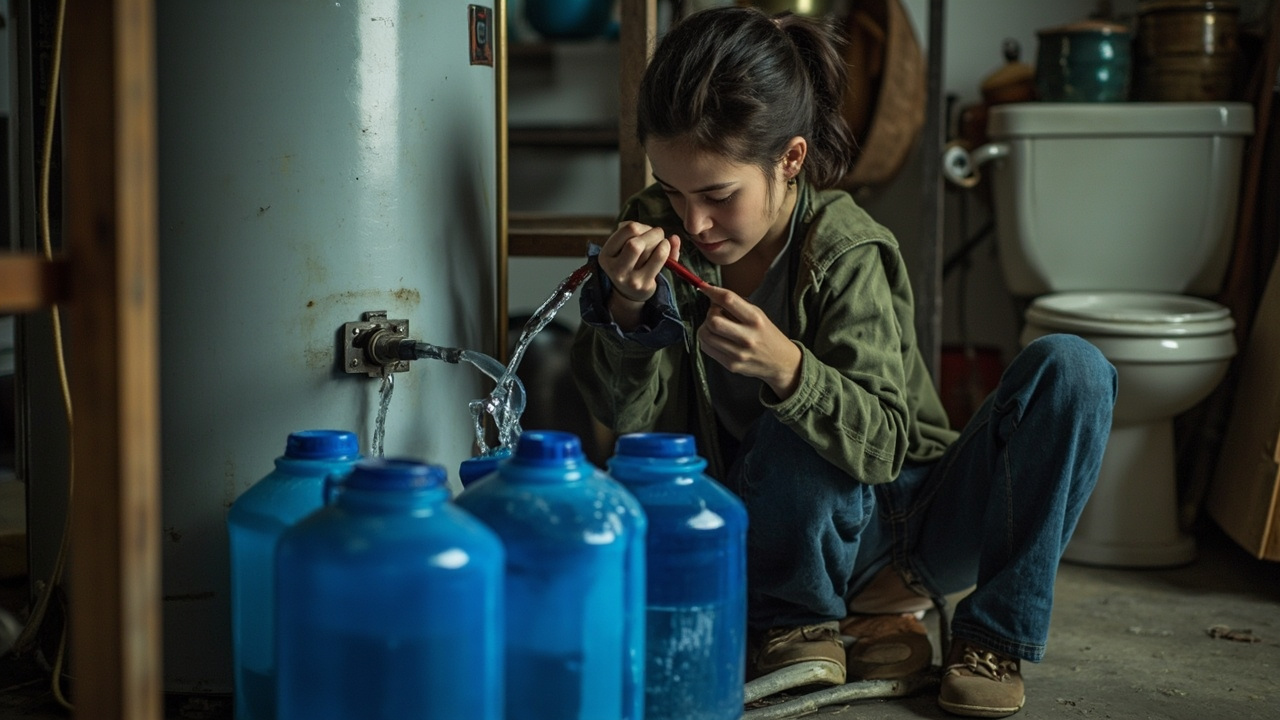
TL;DR: Your water heater holds 40 to 80 gallons of treated drinking water, plus a few gallons in pipes and 1.6 to 3.5 gallons per toilet tank, and you can use it safely if you shut off heat, vent the tank, and drain into clean containers.
Your house already stores more treated drinking water than most shopping-cart stockpiles. Most residential tanks run 40 to 80 gallons, according to Emergency Water Sources in Your Home: Water Heater, Pipes, Toilet Tank, and that analysis cites Colorado State University Extension guidance that hot-water tanks are the best indoor source with an average of 50 gallons. Supply pipes usually hold a few gallons in an average house, with more in a large house with long runs. Toilet tanks add roughly 1.6 gallons in a modern tank and up to 3.5 gallons or more in an older tank, multiplied by the number of bathrooms.
That indoor total matters against the planning baseline. The CDC guidance on creating and storing an emergency water supply calls for at least 1 gallon of water per person, per day for 3 days, and adds try to store a 2-week supply if possible. For two people, the three-day baseline is six U.S. gallons, about 22.7 liters, and for four people it is twelve U.S. gallons, about 45.4 liters. A 50-gallon water heater alone covers a family of 4 for roughly 12 days of drinking and basic sanitation. Families in hot climates, households with pets, and people with certain health or medical needs may need additional water.
Timing raised the stakes on September 20, 2026. The National Hurricane Center puts the peak of the Atlantic hurricane season at September 10, with most activity occurring between mid-August and mid-October, the same window when boil advisories and multi-day outages cluster. Municipal utilities typically have backup generators at treatment plants and pumping stations, according to Power Outage Water Safety: What You Need to Know, which maintain pressure and treatment during many outages. Two scenarios can still compromise municipal safety: a very widespread and prolonged outage of more than 2 to 3 days that exhausts backup fuel at some pumping stations and causes pressure drops, and flooding from storm surge or severe flooding that contaminates supplies directly.
Which indoor sources count as safe to drink?
The CDC lists four safe indoor sources: the water heater tank, melted ice, the toilet tank with never the bowl, and the liquid from canned fruit and vegetables. That four-source list separates drinking water from utility water that is only for cleaning. Pool, spa and hot tub water is for washing, not drinking, and CDC says it can be used for personal hygiene, cleaning, and related uses, but not for drinking.
EPA guidance on where to find water follows the same order, according to How to Purify Water: Emergency and Off-Grid Methods. EPA calls bottled water the best choice, followed by water prepared and stored ahead of time. Water already inside the house, including melted ice cubes and water drained from the hot water tank or pipes, are options EPA names. Flowing surface water such as river or lake water can work, with flowing water generally better than still, stagnant water. EPA says not to use water with floating material, dark color or questionable odor.
How do you drain a water heater without damage or burns?
Order matters when you drain it: kill the gas or the breaker first, then close the cold inlet, then open a hot tap to vent the tank, then drain. The drain valve sits at the bottom of the tank, and a short length of hose gives far more control than a bucket alone.
Kill the heat source first. On a gas unit, A.O. Smith instructions quoted in the home-water report are to turn the control knob to the off position, turn off the electrical supply to the unit, and then close the valve by turning the handle so it is at a right angle to the gas line. On an electric unit, go to the panel because many water heaters have two circuit breakers, and some use a 240-volt supply, and both circuit breakers must be shut off. For an electric water heater afterward, it is critical to make sure the tank is full before turning the power back on, because if there is not enough hot water around the heating element, it will burn out.
Why must the tank cool and vent before draining?
Let it cool because a tank at a normal setting holds water hot enough to scald in seconds. CSU Extension warns to remember that the water coming from the tank can be scalding hot. Give it a few hours if you can, and wear gloves either way, with A.O. Smith recommending heavy gloves to protect yourself. Gas water heaters continue to produce hot water during power outages because gas service is typically unaffected, while electric water heaters and tankless electric heaters do not function without power, according to Power Outage Water Safety: What You Need to Know. The existing hot water stored in a tank-type heater, typically 40 to 80 gallons, remains available as it drains but will not be reheated.
Close the cold water inlet next. That is the valve on the cold line coming into the top of the tank. This isolates the tank from the street, and if the utility has issued an advisory or pressure has dropped, it also keeps contaminated water from being pulled into the tank. Then open a hot water faucet somewhere in the house. Opening a hot tap provides a vent so that water can flow from the tank. Without air coming in the top, vacuum holds the water in. Drain into clean containers by threading a short garden hose onto the drain valve at the bottom or setting a clean pail underneath. CSU Extension says to place a clean pail or bucket under the drain at the bottom of the tank to retrieve the water.
What about sediment, color and refilling?
The first gallon or two from a tank that has never been flushed will be rusty, cloudy and full of mineral grit that settled at the bottom. That is normal. Let it run into a bucket to dump, then start collecting once it runs clear. If it never runs clear, filter sediment through a clean cloth or coffee filter and then disinfect. Cloudy water gets the same cleanup before treatment: let it sit so particles settle, pour off clearer water, then run it through a clean cloth, paper towel or coffee filter.
Refilling reverses the order. Fill the tank completely, open a hot faucet to release air, and only then restore heat or power. Expect the drain valve on an old heater to weep afterward. Plastic valves in particular can fail to reseal, so know where the main shutoff is before touching the valve.
How do you collect water from pipes and toilet tanks?
Supply pipes add a second indoor reserve after the heater. Open the highest faucet in the house to admit air, then open the lowest faucet to drain pipe contents into clean containers. The yield is usually only a few gallons, but that covers drinking for a day or more when combined with melted ice and canned-vegetable liquid.
Use only the toilet tank, never the bowl. Collect the tank water after shutting the toilet supply valve if pressure is failing. Older tanks with larger volumes increase the total, and every bathroom adds its tank to the household sum. If storm flooding reached the plumbing or the tank, flush that source from the plan and rely on stored water instead. Existing stored hot water should be flushed from the tank before use if the outage involved flooding that may have contaminated the tank or plumbing.
Which containers and sanitizing steps keep it safe?
If an advisory is coming, fill the tub, the pots and the washing machine before pressure drops. Sanitize containers first with 1 teaspoon of unscented bleach per quart of water. Unopened commercially bottled water is the CDC preferred emergency source, and commercially sealed bottled water remains safe until the printed expiration date.
For water filled at home, choose food-grade containers with tight lids and never reuse containers that held toxic chemicals. Containers that work share food-grade, FDA-approved HDPE plastic construction, according to Water Storage Containers for Hurricanes: Marion County, FL Prep Guide. Blue-tinted containers block light exposure and prevent algae growth during long-term storage. Seven-gallon containers balance capacity with portability and can be carried when full. One-gallon jugs are lighter and easier to handle but require more storage space. Fifty-five-gallon drums maximize storage in minimal floor space but are impossible to move once filled and require pumps or siphons. Avoid repurposing milk jugs or juice containers because residue and protein buildup create contamination risks.
Where should stored and indoor-reserve water sit?
Store water in a cool location, ideally about 50°F to 70°F, away from direct sunlight and away from gasoline, pesticides and other toxic substances. Interior closets work well. Garages are acceptable if they do not get extremely hot. Basements are suitable where available. Heat and UV exposure degrade plastic containers over time and can leach chemicals into water. Never store containers near gasoline, pesticides, lawn chemicals or household cleaners. Keep emergency storage in dedicated space away from hazards. Stackable designs use garage or closet space efficiently, and reversible spigots that flip inside when not in use protect the spout from damage and contamination.
Label every refillable container drinking water and write the storage date. Mark each container with the fill date using permanent marker. Water filled at home in storage containers should be replaced every six months. Home-filled containers using clean tap water are safe for 6 months in opaque containers stored away from light and chemicals, with rotation every 6 months by draining and refilling. Do not store water in containers that previously held non-food products, in thin plastic bags that may leach chemicals, or in containers with loose lids. When rotation arrives, use older water for plants, washing or toilet flushing and refill with fresh tap water.
How do you treat doubtful tap water after pressure drops?
A Boil Water Advisory means pathogens may be present that can cause illness if consumed without treatment. During an advisory, bring water to a rolling boil for at least one minute, or three minutes at elevations above 6,500 feet, before drinking, cooking, making ice or brushing teeth. Boiling kills bacteria, viruses and parasites but does not remove chemical contaminants. The advisory remains until the utility tests and confirms safety, so do not assume it lifted based on time passed. Check the utility website, app or local news for confirmation.
If stored water is exhausted and tap safety is uncertain, boiling is the most reliable method. Household bleach with unscented 5 to 8.25% sodium hypochlorite calls for 8 drops, or 1/8 teaspoon, per gallon of clear water, or 16 drops for cloudy water. Stir and wait 30 minutes before drinking. The water should have a slight chlorine odour, and if it does not, repeat the dose and wait another 15 minutes. EPA emergency dosing also lists 8 drops of 6% unscented bleach or 6 drops of 8.25% bleach per gallon, with doubled doses when water is cloudy, colored or very cold, followed by 30 minutes of standing. Portable filters using brands such as LifeStraw, Sawyer or Katadyn remove bacteria and parasites but not viruses or chemical contaminants, so in post-flooding conditions they should follow boiling rather than serve as the only treatment. Well users without generator backup lose all water when power stops because the pump needs electricity, and floodwater can introduce bacteria, sewage and chemical contaminants through the wellhead or casing.