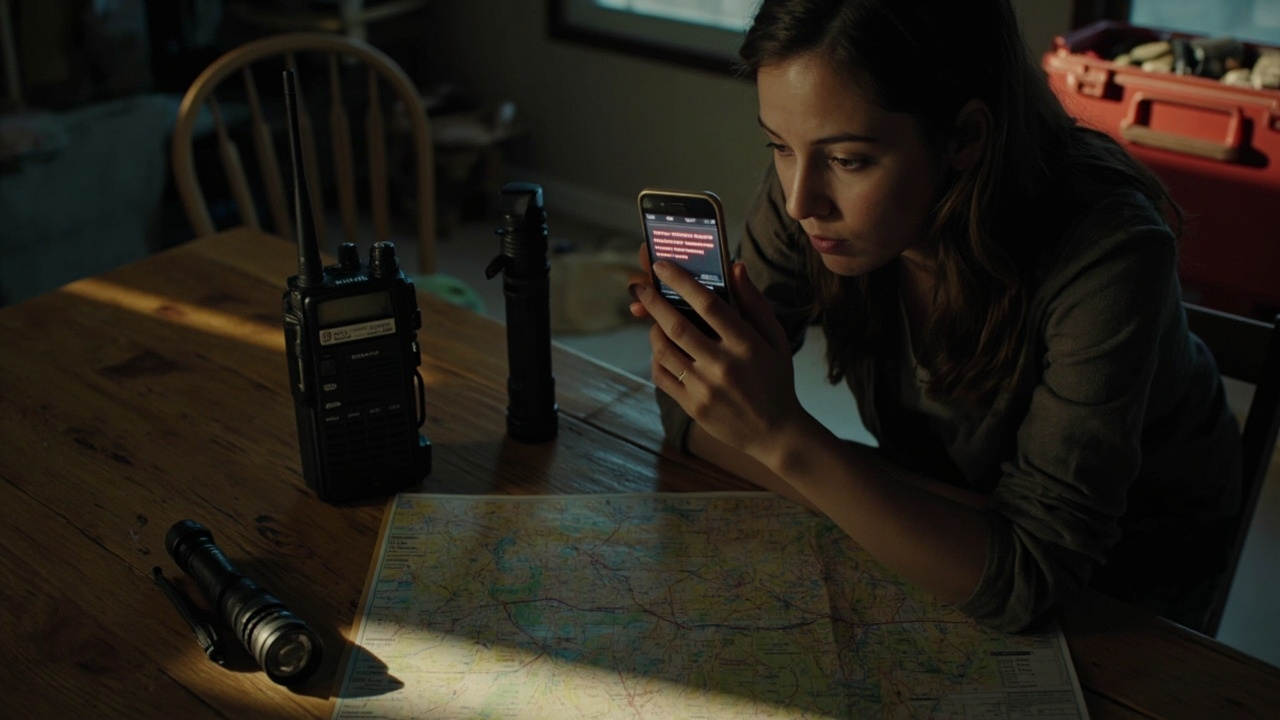
TL;DR: Set phones to receive Wireless Emergency Alerts, keep a NOAA Weather Radio with tone alert plus a battery or hand-crank radio, and store several days of water and food so official instructions can reach you during power and network stress.
What emergency information means at home
After an emergency, you may need to survive on your own for several days, according to Ready.gov's Build A Kit page. Being prepared means having your own food, water and other supplies to last for several days. A disaster supplies kit is a collection of basic items your household may need in the event of an emergency, according to the same Ready.gov checklist.
When emergencies strike, public safety officials use timely and reliable systems to alert you, according to Ready.gov's Emergency Alerts page. That page describes Wireless Emergency Alerts, the Emergency Alert System, NOAA Weather Radio and the Integrated Public Alert and Warning System. This guide explains how each channel reaches a family, how to enable test and live messages, and what information gear to store with food and water.
How Wireless Emergency Alerts reach phones
Wireless Emergency Alerts are short emergency messages from authorized federal, state, local, tribal and territorial public alerting authorities that can be broadcast from cell towers to any WEA-enabled mobile device in a locally targeted area, according to FEMA's Wireless Emergency Alerts page. Wireless providers primarily use cell broadcast technology for delivery. The service is described as a partnership among FEMA, the Federal Communications Commission and wireless providers to enhance public safety.
You can receive these messages when you may be in harm's way without downloading an app or subscribing to a service, according to the same FEMA page. The messages warn of an impending natural or human-made disaster. They are short and can provide immediate, life-saving information.
Authorized senders described by Ready.gov's Emergency Alerts page include state, local, tribal and territorial public safety officials, the National Weather Service, the National Center for Missing and Exploited Children and the President of the United States. FEMA's Wireless Emergency Alerts page lists authorized federal, state, local, tribal and territorial public alerting authorities as sources.
Alerts appear like text messages on mobile devices, according to the Federal Communications Commission overview of Wireless Emergency Alerts. Ready.gov's Emergency Alerts page says the messages look like text messages but are designed to get attention with a unique sound and vibration repeated twice. FEMA's Wireless Emergency Alerts page says the messages have a unique tone and vibration, both repeated twice.
Messages sent through FEMA's Integrated Public Alert and Warning System go to wireless providers, which then push the alerts from cell towers to mobile devices in the affected area, according to the Federal Communications Commission. Ready.gov's Emergency Alerts page says WEAs are sent through FEMA's Integrated Public Alert and Warning System.
Delivery does not depend on network congestion, according to both Ready.gov's Emergency Alerts page and FEMA's Wireless Emergency Alerts page. Ready.gov's Emergency Alerts page adds that the alerts will not disrupt texts, calls or in-progress data sessions. FEMA's Wireless Emergency Alerts page says the messages are free and will not count toward texting limits on a wireless plan, while Ready.gov's Emergency Alerts page says you are not charged for receiving them and there is no need to subscribe.
Location handling is tower-based rather than subscriber-based. FEMA's Wireless Emergency Alerts page says the alerts do not track your location and are broadcast from area cell towers to mobile phones within the defined geographic location. Every WEA-capable phone within range receives the message, according to the same FEMA description. No personal information must be supplied because the system is not subscription based, and receipt is based on location, according to FEMA's Wireless Emergency Alerts page.
Travel does not prevent receipt. You will receive a message even when you are in an area where you do not live or outside the area where your phone is registered, according to FEMA's Wireless Emergency Alerts page. If you travel into an area after a message was sent, a capable device will receive it when the alert remains active.
Children also receive alerts on WEA-enabled mobile devices, according to Ready.gov's Emergency Alerts page. That page advises parents and guardians to talk with children about the alerts and staying safe in an emergency.
The five Wireless Emergency Alert categories
FEMA's Wireless Emergency Alerts page groups messages into National Alerts, Imminent Threat Alerts, Public Safety Alerts, AMBER Alerts and opt-in test messages.
National Alerts are a special class sent only during a national emergency. Imminent Threat Alerts cover natural or human-made disasters, extreme weather, active shooters and other threatening emergencies that are current or emerging. Public Safety Alerts contain information about a threat that may not be imminent or after an imminent threat has occurred, and they are less severe than imminent threat alerts.
America's Missing: Broadcast Emergency Response alerts are urgent bulletins issued in child-abduction cases, according to the same FEMA grouping. Opt-in test messages assess the capability of state and local officials to send their messages, and the message will state that it is a test.
Follow the action advised by the alert, according to FEMA's Wireless Emergency Alerts page. The message shows the type and time, any action to take and the agency issuing it. The message will be no more than 360 characters. More details can come from local authorities, local news or trusted social media sources.
What the Emergency Alert System adds
The Emergency Alert System is a national public warning system that allows the president to address the nation within 10 minutes during a national emergency, according to Ready.gov's Emergency Alerts page. Other authorized federal, state, local, tribal and territorial alerting authorities may use it to deliver weather information, imminent threats, AMBER alerts and local incident information targeted to specific areas.
Distribution uses broadcast television and radio, satellite digital audio services, direct broadcast satellite providers, cable television systems and wireless cable systems, according to the same Ready.gov page. The president has sole responsibility for determining when the national-level system will be activated. FEMA and the Federal Communications Commission are responsible for national-level tests and exercises.
The Emergency Alert System is also used when all other means of alerting the public are unavailable, according to Ready.gov's Emergency Alerts page. That fallback role is why a household plan should not rely only on a mobile phone.
How NOAA Weather Radio and IPAWS fit together
NOAA Weather Radio All Hazards is a nationwide network of radio stations that broadcast continuous weather information from the nearest National Weather Service office based on your physical location, according to Ready.gov's Emergency Alerts page. It broadcasts official warnings, watches, forecasts and other hazard information 24 hours a day, seven days a week. It also broadcasts alerts for non-weather emergencies such as national security or public safety threats through the Emergency Alert System.
The Integrated Public Alert and Warning System is FEMA's national system for local alerting, according to the same Ready.gov page. It gives federal, state, local, tribal and territorial public safety agencies the ability to send Wireless Emergency Alerts, Emergency Alert System alerts, weather and non-weather emergency messages simultaneously through NOAA weather radios and alerts through systems like sirens and digital billboards.
A recent county-level change shows how local agencies now use that national backbone. The Ottawa County and Lucas County emergency management agencies announced a switch to the Integrated Public Alert and Warning System for public notification about an emergency at the Davis-Besse Nuclear Power Station, according to the 13abc report titled New alert system for Davis-Besse Nuclear Power Station to be tested Friday. A test was scheduled for noon on Oct. 10, 2025, with a wireless message to mobile devices within 10 miles of Davis-Besse. Only devices configured to receive test alerts were to display that test transmission, and residents could enable the option in notification settings.
Fred Petersen, director of Ottawa County EMA, said the agencies were committed to keeping communities safe and informed and that the system allows rapid, effective outreach with response information, according to the same 13abc report. The press release cited by 13abc said FEMA and the Nuclear Regulatory Commission approved the transition and that the new method delivers timely and reliable emergency alerts to mobile devices, radios and televisions. The system was to replace the legacy siren network within the 10-mile Emergency Planning Zone around Davis-Besse on Nov. 3, according to the same report.
Phone settings that decide whether you see the message
Wireless providers sell devices with alert capability included, according to FEMA's Wireless Emergency Alerts page. To confirm whether a phone can receive the messages, contact the wireless provider. All major providers participate on a voluntary basis.
Older phones may not be capable, and some models require the user to enable the messages, according to Ready.gov's Emergency Alerts page. Some providers label the messages Government Alerts or Emergency Alert Messages. The Federal Communications Commission maintains a registry of participating providers.
If someone nearby received a message and you did not, inadequate cell reception is one possible cause, according to FEMA's Wireless Emergency Alerts page. On some makes and models, being on a call can prevent display, while more generally a message received during a call is delayed until the call ends. A phone set to off or airplane mode will miss it. Other causes include no connection to a cell site broadcasting the alert, connection to a site that is not broadcasting it, maintenance or outage at the site, connection through a Virtual Private Network, or opting out of receipt. The opt-in and opt-out control is typically in the notification settings menu.
Repeated display of the same message most likely reflects an issue with the device, according to the same FEMA guidance. Mobile phones should ignore later rebroadcasts, but a handset can become stuck in a loop. Powering the device off and turning it back on may help.
Information gear to store with food and water
A basic emergency supply kit could include water at one gallon per person per day for several days for drinking and sanitation, plus at least a several-day supply of non-perishable food, according to Ready.gov's Build A Kit page. FEMA's evacuation FAQ lists the same water amount and a several-day food supply among items to take when leaving home before or during a disaster.
For information, the Ready.gov checklist specifies a battery-powered or hand-crank radio and a NOAA Weather Radio with tone alert, a flashlight, extra batteries, a cell phone with chargers and a backup battery, a whistle to signal for help and local maps. FEMA's evacuation FAQ separately lists a battery-powered or hand-crank radio, flashlight, extra batteries, whistle, cell phone with chargers and backup battery, manual can opener and local maps.
Store the kit in airtight plastic bags inside one or two easy-to-carry containers such as plastic bins or a duffel bag, according to Ready.gov's Build A Kit page. Additional supplies named on that list include soap, hand sanitizer and disinfecting wipes; prescription medications; non-prescription pain relievers, anti-diarrhea medication, antacids or laxatives; prescription eyeglasses and contact lens solution; infant formula, bottles, diapers, wipes and diaper rash cream; pet food and extra water; cash or traveler's checks; copies of insurance policies, identification and bank account records saved electronically or in a waterproof, portable container; a sleeping bag or warm blanket for each person; a complete change of clothing appropriate for climate and sturdy shoes; a fire extinguisher; matches in a waterproof container; feminine supplies and personal hygiene items; mess kits, paper cups, plates, paper towels and plastic utensils; paper and pencil; and books, games, puzzles or other activities for children.
Other protective and utility items on the basic list are a first aid kit, a dust mask to help filter contaminated air, plastic sheeting, scissors and duct tape to shelter in place, moist towelettes, garbage bags and plastic ties for personal sanitation, and a wrench or pliers to turn off utilities, according to the same Ready.gov checklist.
Where to keep kits and how to maintain them
Because you do not know where you will be when an emergency occurs, prepare supplies for home, work and cars, according to Ready.gov's Build A Kit page. At home, keep the kit in a designated place ready in case departure must be rapid, and make sure all family members know where it is kept. At work, be prepared to shelter for at least 24 hours with food, water, necessities such as medicines and comfortable walking shoes in a grab-and-go case. In a car, keep emergency supplies in case stranding occurs.
After assembling the kit, maintenance keeps it ready, according to the same Ready.gov guidance. Keep canned food in a cool, dry place. Store boxed food in tightly closed plastic or metal containers. Replace expired items as needed. Reconsider needs every year and update the kit as family needs change. A truly effective kit is tailored to the household, with individual needs incorporated, according to FEMA's evacuation FAQ.
Sources referenced
- Emergency Alerts | Ready.gov (https://www.ready.gov/alerts)