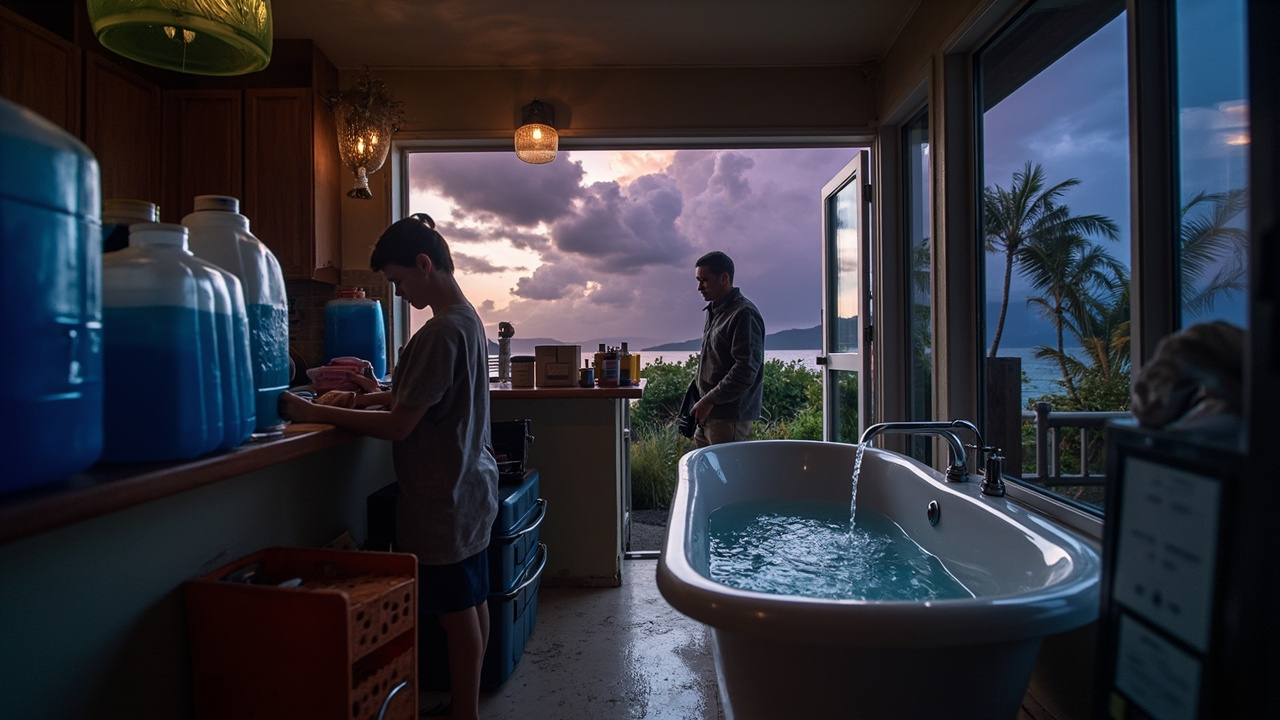
TL;DR: Kauai Families Told To Store Water Now And Conserve Under Hurricane Warning
TL;DR: The Kauaʻi Department of Water told customers to store at least one gallon of drinking water per person per day and to limit all use to essential needs as Hurricane Lowell approached as a Category 3 storm.
The newest verified action came on September 7, 2026, when the department placed an island-wide conservation notice into effect immediately because of Hurricane Lowell's eastward shift, according to the Kauaʻi Department of Water. That order asked households to restrict consumption to cooking, drinking, personal hygiene, laundry, and sanitation in an effort to prevent a complete loss of service. The notice stays active until officials lift it, with updates posted at kauaiwater.org and recorded at 808-245-5455.
The warning followed guidance issued September 6, 2026, at 1:38 p.m. HST in Līhuʻe that urged customers to build emergency supplies before conditions deteriorated, according to Hawaii News Now. Officials linked possible interruptions to wind damage, flooding, toppled trees, and loss of electricity to pumps and wells. Repair teams were described as ready, but work could start only after sites became safe and reachable.
Hurricane Lowell Moved Closer To Kauaʻi County
Warning Covers Kauaʻi And Niʻihau Into Tuesday
A hurricane warning remained in effect for Kauaʻi County, covering both Kauaʻi and Niʻihau, according to the County of Kauaʻi bulletin issued at 1:25 p.m. on September 7, 2026. Hurricane conditions were forecast to start that day and persist through the evening and into Tuesday. Mayor Derek Kawakami urged residents to complete last-minute tasks that morning, leave roadways by midday, and remain indoors.
The mayor advised people in coastal or unsafe locations to arrange shelter with family or friends, according to the same county bulletin. As a final option, residents could bring a go-kit to a refuge area. Officials also asked the public not to call 911 for weather or road information so dispatchers could handle life-threatening calls.
Position, Winds, Rain And Surf On September 7
In its 8 a.m. advisory cited by the county, the National Weather Service placed Hurricane Lowell about 325 miles southwest of Līhuʻe, traveling north-northeast at 15 mph with maximum sustained winds of 115 mph. The system held Category 3 strength, with its center projected to pass just west of Kauaʻi and Niʻihau that night. Deterioration was expected during the afternoon.
Hurricane-force winds reached outward 60 miles from the center, while tropical-storm-force winds extended 175 miles, according to the County of Kauaʻi bulletin. Winds over ridges and downslope areas could run as much as 30 percent stronger than coastal readings. Forecasters anticipated another 6 to 10 inches of rain, with localized totals near 16 inches, after measured rates of 1 to 2 inches per hour. The Hanalei River was flooding, with water expected downstream toward Hanalei town and sections of Kūhiō Highway near the bridge.
Surf along south-facing shores was forecast to build to 20 to 30 feet during the afternoon and evening, with a 2- to 4-foot surge possible above ground in normally dry coastal ground, according to the same county update. Large and destructive waves could accompany the surge, prompting road closures and coastal inundation. Several tornadoes were listed as possible near Kauaʻi and Niʻihau from that afternoon through the night.
Why Tap Service Could Stop During The Storm
Infrastructure And Power Risks
The department tied possible outages to physical harm to pipes and facilities plus interruptions to electricity serving sources and pumps, according to Hawaii News Now. Tropical-storm-force winds, flooding, and fallen trees were identified as the relevant hazards for Kauaʻi County. Even homes without structural damage could lose pressure if wells and booster stations lost power.
The county bulletin added that outages or pressure drops could occur because storms affect pumps and wells. Customers were told to use water sparingly during the storm and through any outage that followed. Reporting of outages, low pressure, or main breaks was directed to DOW at 808-245-5400.
Repairs Must Wait For Safe Access
Response crews were positioned to act, but restoration could begin only when conditions allowed safe entry, according to Hawaii News Now. That timing gap is the reason officials emphasized household storage before the worst weather arrived. Conservation during the event was presented as a way to keep storage tanks from emptying while power was out.
How Much Water Kauai Households Should Keep
The One-Gallon Baseline Per Person Per Day
Customers should hold a minimum of one gallon per person per day for emergency kits, to cover needs until restoration, according to Hawaii News Now. The county's September 7 update repeated the same baseline and told residents to fill clean containers immediately before conditions worsened. No end date for storage needs was given, because duration depended on damage and power recovery.
Households with more members need proportionally larger reserves. The guidance did not set a fixed number of days, instead linking the supply to the period until service returns. That approach lets families scale storage to space and household size while meeting the daily minimum.
Bathtubs And Buckets For Non-Drinking Tasks
Beyond drinking supplies, the county advised filling bathtubs and buckets for flushing toilets and cleaning, according to the County of Kauaʻi bulletin. That separation preserves treated drinking water for ingestion while providing volume for sanitation. Rainwater, if collected during the storm, was identified for non-potable purposes only, according to Hawaii News Now.
In an outage, residents were told not to run appliances that require water and not to let water heaters empty, according to the Kauaʻi Department of Water. Those steps reduce damage to equipment and avoid further strain on a depressurized system. Updates on system status were to be posted online and by phone.
Proper Containers And Storage Location
What To Use And What To Avoid
Suitable vessels are clean, FDA-approved food-grade containers made for water, according to Hawaii News Now. Containers that once held hazardous materials were listed as unsuitable. Vessels retaining strong food odors were also to be avoided, as were easily breakable materials such as glass.
Filling should use tap water with only minimal air space beneath the cap. Storage should be in a cool, dark place. Those three handling points — clean approved container, full fill, protected location — were presented as the core of safe household storage.
Handling After Filling
Once filled, containers should remain closed until needed. The department did not specify rotation intervals in the cited guidance, focusing instead on immediate storm readiness. Families using bathtubs or buckets for utility water should keep that supply distinct from drinking containers to prevent cross-use.
The Honolulu Board of Water Supply's separate distribution of storage bags on Oʻahu, with a handle cap and individual wrapping, was noted in related coverage, but Kauai's instruction centered on household containers already on hand, according to Hawaii News Now. The emphasis remained on acting before winds and flooding limited movement.
Conservation Rules Now In Effect
Essential Uses Only
Effective immediately on September 7, island customers were directed to confine use to essential needs, according to the Kauaʻi Department of Water. Listed essentials included cooking, drinking, personal hygiene, laundry, and sanitation. The stated purpose was to help avoid a full service outage.
A conservation request is commonly issued during power failures to stop storage tanks from draining, according to Hawaii News Now. Under such a notice, customers should supply only drinking, cooking, and hygiene needs and switch off automatic fixtures. The September 7 order added laundry and sanitation to the allowed essential list for this event.
Switch Off Automatic Draws
Conservation measures include turning off fixtures and equipment that draw water automatically, such as ice machines and irrigation systems, according to the Kauaʻi Department of Water. Disconnecting automated drawing devices was also advised for the storm period, according to Hawaii News Now. Those loads can rapidly deplete tanks when pumps lack power.
The notice remains in force until the department formally lifts it. Additional county services and facilities could close with little or no notice as conditions evolved, according to the County of Kauaʻi bulletin.
Do Not Drink And Boil Water Notices Explained
When Each Advisory Applies
Notices vary with system conditions during severe weather, according to Hawaii News Now. If quality is compromised, officials may issue a Do Not Drink advisory. Separately, officials may require boiling when treatment or intrusion concerns warrant that step.
During a Do Not Drink advisory, tap water must not be used for drinking, making ice, brushing teeth, washing dishes, or preparing food until officials declare it safe. That restriction applies even if the water looks clear. Residents should wait for an official all-clear rather than judging safety by appearance.
Boiling And Bleach Disinfection Steps
A Boil Water Notice calls for bringing tap water to a rapid boil for about three minutes before use, according to Hawaii News Now. If boiling is impossible, federal guidance cited in that report points to chemical disinfection for clear water. The cited method from the Centers for Disease Control and Prevention and the Environmental Protection Agency calls for eight drops of regular, unscented liquid chlorine bleach per gallon for clear water, or 16 drops for cloudy water, followed by a 30-minute stand time.
The county added a parallel caution not to use water suspected of flood contamination, according to the County of Kauaʻi bulletin. Floodwater can carry hazards that boiling and household bleach steps are not described as addressing in the cited storm guidance. When contamination is suspected, the safer course under the advisories is to rely on stored supplies and await official direction.
What To Do During And After The Storm
During High Winds And Flooding
Customers should follow local news, begin conserving immediately, and save rainwater only for non-drinking purposes, according to Hawaii News Now. Automated devices that draw water should be disconnected. The county asked residents to shelter in place, check on friends and neighbors, then remain sheltered until conditions eased Tuesday.
Road impacts underscored the need to stay put. Kūhiō Highway near Hanalei Bridge closed at 10:45 a.m. on September 7 because of flooding and elevated stream levels, according to Hawaii News Now. Līhuʻe Airport was set to close at 2:30 p.m., refuse collection was suspended at noon, and The Kauaʻi Bus left its regular schedule to support transport to refuge areas, according to the County of Kauaʻi bulletin.
After The Weather Clears
Crews will evaluate infrastructure once the storm passes, according to Hawaii News Now. If lines are damaged or conservation orders remain active, customers must keep conserving until the department officially ends the restrictions. Operating water-dependent appliances prematurely could worsen equipment issues or pressure problems.
State and county offices, public schools, Kauaʻi Community College, and judiciary facilities on Kauaʻi were to be closed Tuesday, September 8, while essential government and emergency operations continued, according to Hawaii News Now. Parks, campgrounds, Wailua Golf Course, state parks, and forest reserves were closed until further notice. Residents were told to keep bins available for refuse pickup where service continued on schedule, while recognizing that further closures could occur without advance warning.
Sources referenced
- Kauai residents advised to store water ahead of Hurricane Lowell | Hawaii News Now (https://www.hawaiinewsnow.com/2026/09/06/kauai-residents-advised-store-water-ahead-hurricane-lowell/)
- Water conservation in effect for Kauaʻi – Kauaʻi Department of Water (https://www.kauaiwater.org/water-conservation-in-effect-for-kaua%ca%bbi/)