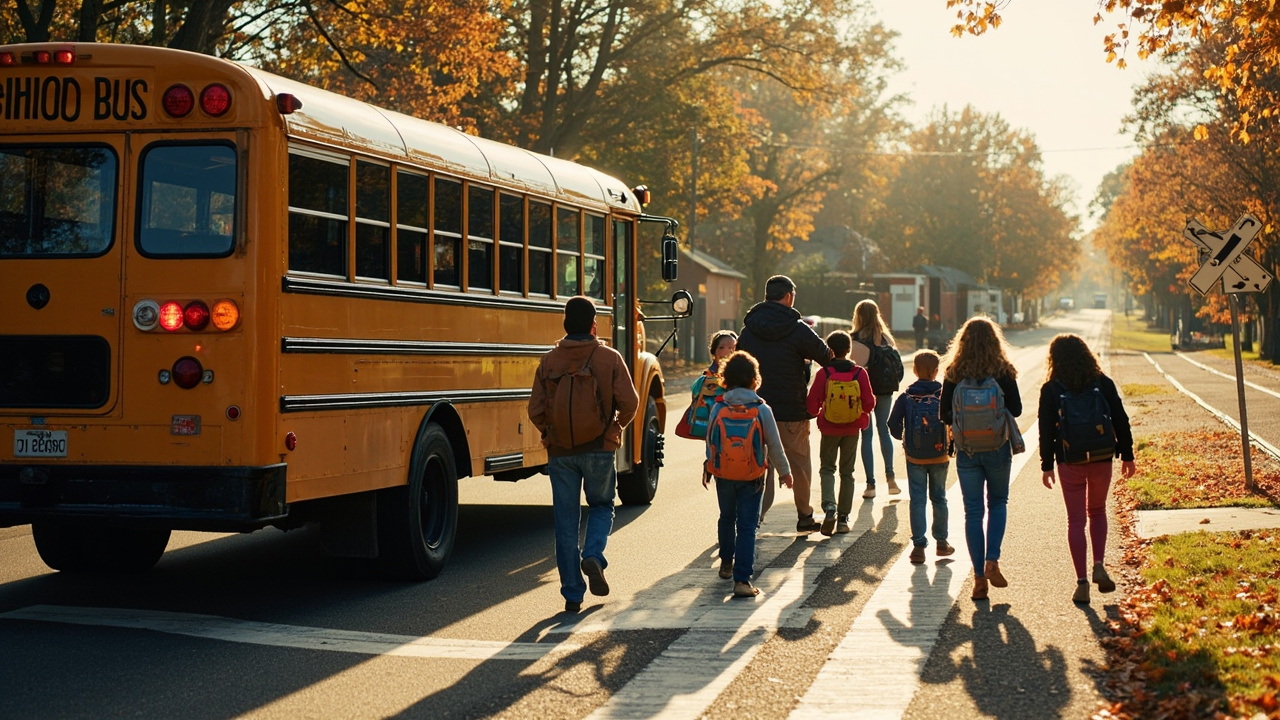
TL;DR: Marshall County officials say a safer school year comes from shared action on roads, at bus stops, on rail crossings, and in family emergency plans, according to the Times Republican.
Shared Duty Forms the Core Message
A joint message from the Marshall County Communications Center and Marshall County Emergency Management frames back-to-school safety as work for the whole community. The message was written by Rhonda Braudis and Kim Elder and appeared in the Times Republican on August 29, 2026.
The authors list students, parents, teachers, school staff, bus drivers, motorists, first responders, emergency management, and 911 Communications Specialists as participants in daily safety. According to the Times Republican, no single agency, school, or family carries the duty alone.
The same message names five daily choices: leaving home earlier in the morning, setting the phone aside while driving, stopping for school buses, watching for children at crosswalks, and talking with children about emergency response. Those behaviors are presented as ways to support a safer school year.
Fall routines described in the piece include earlier wake times, students meeting new teachers, buses traveling neighborhood roads again, and full school parking lots. The authors ask drivers to slow down, stay alert, and allow extra courtesy during the transition.
Traffic Patience Around Schools
School in session changes daytime traffic flow, according to the Times Republican. Areas with light summer traffic develop morning drop-off congestion and afternoon dismissal delays.
Buses stop more often during the school year. Teen drivers return to school parking lots. Children travel by bicycle and on foot and play near roadways.
The guidance directs drivers to remain patient in those zones. Running late does not permit speeding through a school zone, passing a bus improperly, blocking a crosswalk, or honking in a drop-off line. Families are urged to plan ahead, depart earlier, and expect delays.
The message adds that a child playing near the street may not recognize danger as clearly as an adult driver. That difference is given as a reason for added caution near schools and neighborhoods.
Bus Lights Tell Drivers What To Do
School-bus rules receive extended attention. Iowa Department of Transportation guidance cited in the Times Republican says drivers should slow and prepare to stop when a bus shows amber warning lights.
When a bus is stopped with flashing red lights and an extended stop arm, motorists must follow Iowa stopping requirements. They must remain stopped until the signals are withdrawn and the bus starts moving again.
Drivers are also asked to observe the ground around the bus rather than focusing only on the vehicle. Children may be crossing the road or approaching from a spot that is hard to see.
Parents are asked to rehearse bus-stop conduct before classes begin. Children should stay back from the curb, avoid running or playing beside the roadway, and wait until the bus has fully stopped before moving toward it. Boarding should wait for the driver’s signal that entry is safe.
Two bus-danger rules are stated directly: never walk behind a school bus, and never reach under or near the bus unnoticed to recover a dropped object. A child who drops something near the bus should alert the driver instead.
The authors recommend repeated instruction until those habits become automatic. Repetition is framed as the method for turning basic rules into second nature.
Walkers and Bicycle Riders Need Space
Drivers near walkers and bicycle riders are told to scan well ahead around schools, intersections, parked cars, and neighborhoods. According to the Times Republican, children can be difficult to see and may move in ways drivers do not expect.
Parents of younger children can walk the school route together before independent travel begins. During that walk, adults can identify safe crossing locations and rehearse looking left, right, and left again before entering the street.
Students who ride bicycles should wear well-fitted helmets. They should obey traffic signals. They should avoid distractions that remove eyes or ears from the road.
Crossing discipline and helmet use are presented alongside route practice as practical tools for households with walkers and riders.
Rail Crossings Demand a Full Stop Mindset
Railroad safety is identified as a Marshall County concern because school travel and errands can cross tracks. The central reminder is that an unseen train may still be approaching, according to the Times Republican.
Trains may come from either direction, on any track, at any time. They may be quieter than expected and faster than they appear. Trains cannot stop quickly. The standing instruction is to always expect a train.
Motorists must not drive around lowered crossing arms or gates or flashing lights. Drivers must not enter a crossing unless the vehicle can clear it completely. Drivers must not stop on tracks while waiting in traffic.
After one train passes, travelers should look both ways because another train may be approaching on a second track. Children should cross only at designated crossings and should never treat tracks as a shortcut, walking path, or gathering place.
A stalled or stuck vehicle on tracks calls for immediate exit. All occupants should leave the vehicle and move away from the tracks quickly, even when no train is visible. Travelers should then find the blue-and-white Emergency Notification System sign, call 911, and provide the crossing identification number to the 911 Communications Specialist. When the sign cannot be found, callers should call 911 and describe the crossing and the emergency.
School Contacts Must Stay Current
Preparation continues after students reach class. Families should learn how their school will communicate during severe weather, a security issue, an evacuation, or another emergency, according to the Times Republican.
Schools need current phone numbers, emergency contacts, medical information, and the names of people authorized to pick up each child. Outdated numbers or addresses should not be discovered during a crisis. Changes involving phone numbers, addresses, medications, or family situations should be reported promptly.
News-Talk 1230 KFJB reported on August 28, 2026, that Marshall County Emergency Management Coordinator Kim Elder urges discussion of different scenarios with family members, schools, or co-workers. Knowing the arrangement in advance reduces the thinking required after an emergency begins.
Elder described preparedness as assembling a puzzle, with each part of life forming another piece that helps protect the household. That description appeared in reporting by News-Talk 1230 KFJB.
Household Plans Tie School and Home Together
Every household should maintain a basic family emergency plan, according to the Times Republican. The plan should cover where members would meet if return home were impossible, whom each person would contact, and how children would reunite with parents and caregivers.
Those three questions — meeting place, contact person, and reunification method — give families a compact structure for school-year planning. The school-contact records above supply the information a reunification step would depend on.
Elder also recommends checking emergency kits every six months or more often, according to News-Talk 1230 KFJB. Batteries left inside devices can corrode, so storage checks matter.
When households review a plan, Elder suggests handling and using kit items rather than only discussing them. According to News-Talk 1230 KFJB, physically touching the equipment helps family members understand what is available and how it works.
Together, the Times Republican safety message and the News-Talk 1230 KFJB preparedness report point families toward the same sequence: update school records, rehearse travel behavior, learn rail-crossing response, confirm school communication methods, write down meeting and contact decisions, and inspect the home kit on a six-month cycle.
Sources referenced
- Back to school, ready for anything: Safety and emergency preparedness in Marshall County - Times Republican (https://www.timesrepublican.com/opinion/columnists/2026/08/back-to-school-ready-for-anything-safety-and-emergency-preparedness-in-marshall-county/)
- Marshall County Emergency Management Says Talk and Walk Through Emergency Plans | News-Talk 1230 KFJB (https://www.1230kfjb.com/2026/08/28/marshall-county-emergency-management-says-talk-and-walk-through-emergency-plans/)